When Everyone's Busy but Nothing's Moving — Debugging My Team with the Waterline Model (Part 1)
Something felt off about my team, and I couldn’t put my finger on it.
Everyone was busy. Calendars were packed. People were shipping code, fixing bugs, attending syncs. From the outside, it looked like a team in motion. But when I zoomed out and asked myself — what did we actually deliver in the last two cycles? — I couldn’t point to much.
We were spread thin across too many workstreams, yet the most critical problems weren’t getting solved with conviction. Important decisions got made, then unmade, then revisited. Priorities drifted. People were heads-down on their own tracks, but nobody seemed to know how the pieces fit together.
As a PM, I felt like I’d done everything I was supposed to do. I’d created clarity on goals — or at least I thought I had. I’d written docs, prepared leadership reviews, ran the rituals. I was putting in the effort. But it was like gripping sand: the harder I squeezed, the more it slipped through my fingers.
The frustrating part wasn’t that people weren’t trying. They were. That’s what made it so confusing. Everyone was working hard. Nobody was slacking off. Yet the collective output didn’t match the collective effort.
I kept circling back to the same uneasy question: Is it the people? Am I not pushing hard enough? Are we just not good enough?
Then I stumbled on a framework that completely reframed how I was thinking about the problem.
The Waterline Model
Molly Graham, who spent two decades leading teams at some of the best-known companies in tech, wrote about a diagnostic tool she calls the Waterline Model. The core idea is simple but powerful:
When a team isn’t working, don’t start by blaming the people. Start by examining the system they’re operating inside.
Imagine your team is a boat. The destination is your goal. When the boat isn’t moving well, the instinct is to look at the crew — “they’re not rowing hard enough” or “those two don’t get along.” But the Waterline Model says: before you judge the crew, look at what’s happening below the waterline that’s making things harder than they should be.
The model breaks team problems into four layers, from shallowest to deepest:
Layer 1: Structure
This is the stuff closest to the surface — goals, roles, expectations, ownership, org design, how success is defined. When structure is broken, people don’t know what they’re supposed to do, or they think they know but everyone has a different answer. They row in different directions, not because they’re bad at rowing, but because nobody clarified where the boat is going.
According to Molly, this is where the majority of team problems actually live. And it’s the layer that leaders most often skip.
Layer 2: Dynamics
This is how the team actually works together day-to-day — not what’s written in a doc, but what’s experienced. How decisions get made. What happens when someone disagrees. Whether it feels safe to move fast or whether people have learned that speed gets punished.
The key insight at this layer: people adapt rationally to whatever system they’re in. If decisions keep getting reversed, people will slow down and over-align. If speaking up gets you criticized, people will stay quiet. The behavior you see is a logical response to the environment — even if the behavior is exactly what you don’t want.
Layer 3: Interpersonal
Tension between two specific people — lack of trust, unresolved conflict, style clashes. These are real, but Molly’s point is that they’re often caused by problems higher up. Two people stepping on each other’s toes might look like a relationship problem, but it could actually be a structure problem — overlapping ownership that nobody clarified.
Layer 4: Individual
What’s happening inside a single person — skill gaps, personal stress, motivation, fit. This is the deepest layer, and the model says you should only diagnose here after you’ve ruled out the layers above.
The rule of thumb is memorable: snorkel before you scuba. Start at the surface. Check the shared systems — goals, roles, decision-making — before you start diagnosing personalities. If structure is broken, even great people will underperform. Fix the system first, then evaluate the people.
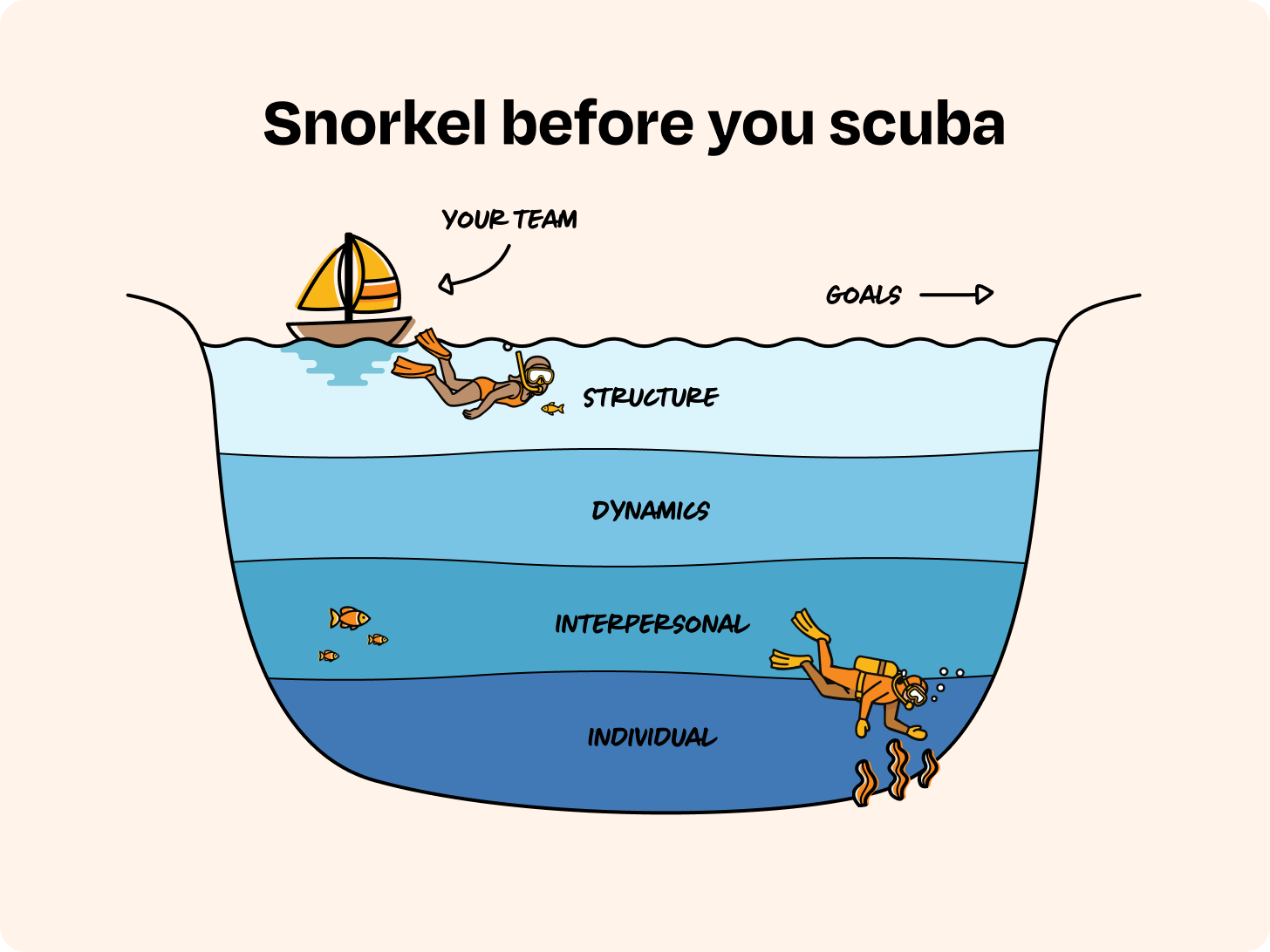
This hit me hard. Because my instinct had been exactly what Molly warned against: I was starting to wonder if certain individuals were the problem. The Waterline Model told me to slow down and check the system first.
Turning It Into an Experiment
I decided to treat this as a leadership experiment. Instead of sitting in my own head trying to figure out what was wrong, I would go directly to the team and use the Waterline Model as a diagnostic lens.
I picked a few team members for 1:1 conversations. Not everyone — I chose people who were most likely to surface useful signal at each layer:
- Someone who had recently experienced a significant role change and would be the first to feel structural ambiguity
- Someone working on the front lines of execution, where unclear goals and missing definitions would be most painful
- Someone sitting at the cross-functional boundary between different sub-teams
I was deliberate about framing. I didn’t want these conversations to feel like evaluations. I opened each one the same way:
“I want to make sure I’m doing my part to support your work well. I’d love to hear what’s working for you, what’s getting in your way, and where I can do better as your PM.”
Spotlight on me and the system. Not on them.
Then I asked simple questions: What do you think is our team’s most important goal right now? What do you personally own? How do you know if you’re doing a good job?
What I heard back changed how I understood everything.
What I Found Below the Waterline
Structure: Almost Every Crack Was Here
Roles had shifted without being redefined.
We’d recently had a leadership change in one of our sub-teams. A new manager joined, and someone who had previously been the de facto technical lead found their scope gradually redistributed — some of their responsibilities went to one person, some to another. But there was never a moment where someone sat down and said: “Here’s the new structure. Here’s what you own now. Here’s why.”
It just… happened organically. Which meant the person who used to be the go-to technical voice was now in an ambiguous space — not clearly owning what they used to own, but not clearly owning anything new either. When they wanted to contribute to key decisions, they weren’t sure how to plug back in.
This wasn’t anyone’s fault. It was a structural gap that nobody had explicitly addressed.
The eval infrastructure existed on paper — but not in reality.
The new manager had driven a significant technical initiative — a new approach to one of our core algorithms. The direction might have been right. And to be fair, we’d done some of the upstream work: the goal was defined, and the eval metrics had been agreed upon.
But here’s where it fell apart. Defining what to measure is only half the job. You also need the how — the eval pipeline that runs the tests, the curated dataset to evaluate against, the tooling that turns a metric definition into an actual number you can look at and act on. That infrastructure had never been built.
The reason was both mundane and devastating. The team member who owned the evaluation framework — the person who was supposed to build the pipeline and assemble the dataset — was leaving. And we didn’t know. By the time we found out, the work had been silently stalled for weeks. We’d been operating under the assumption that someone was making progress on eval. Nobody was.
It’s a failure mode I’d never thought about before: phantom ownership. On paper, the work had an owner. In reality, that owner was already mentally out the door. The structural gap wasn’t that nobody had been assigned — it was that nobody had verified the assignment was still alive.
The result: the work got done, but nobody could confidently say whether the outcome was good or bad. One team member who tested it internally felt strongly that the new version had serious issues, but there was no formal mechanism to raise that concern. They ended up flagging it privately to their manager with an urgent “you need to look at this carefully” — a workaround for a missing system.
The person on the front line was operating without a map.
One team member had been single-handedly responsible for quality improvements. When I asked them how it was going, the picture was stark:
- They didn’t know which quality issues were high priority vs. low priority
- There was no shared definition of what “quality” meant in concrete terms — what counts as a problem? What does “fixed” look like?
- They had no regular meeting or forum to discuss quality direction with anyone
- They weren’t sure whether certain problems should be solved on the algorithm side or the client side
- A colleague who had owned the evaluation framework was leaving, and nobody had clarified who would take over
Their words stuck with me: “It feels like nobody else cares about quality. I’m the only one working on it.”
That wasn’t a motivation problem. That was a person placed inside a structure with no goal definition, no prioritization framework, no feedback loop, and no forum for alignment — and then expected to deliver results.
Dynamics: The Information Flow Had Broken
Beyond structure, I noticed a clear dynamics problem.
There was no regular cadence for discussing quality as a team. Each workstream operated in isolation — people knew what they were doing, but not what others were doing or where things were blocked. Several projects had no end-to-end owner, so progress was opaque.
The team had also stopped doing regular deep-dives with our leadership chain. Two cycles had gone by without the kind of detailed review that keeps leadership informed and the team accountable. Our leaders cared about this project — but they’d lost visibility into how it was going.
Internally, there was no rhythm of sharing wins, updates, or learnings. People described a lack of momentum — the feeling of “we’re all busy, but we’re not winning together.”
The Moment That Hit Hardest
One of my teammates told me that near the end of last cycle, they had a moment where they felt like if they didn’t step in and personally drive things, the cycle’s mission would fail.
They said they’d been close to burning out.
I hadn’t seen it. I’d been so focused on my own PM work — writing specs, preparing reviews, aligning with leadership — that I’d missed how much one of my most capable teammates was struggling. Not because they weren’t good enough. Because the system around them had failed to provide clarity, ownership, and support.
That was a wake-up call.
Connecting the Dots
When I laid all the findings side by side, the pattern was unmistakable. Nearly every problem traced back to Layer 1: Structure.
- Roles had shifted without being explicitly redefined → people didn’t know what they owned
- Eval metrics were defined but the pipeline and dataset never got built → work got done but nobody could evaluate the outcome
- Quality had no shared definition → the person responsible was flying blind
- Key ownership was about to go vacant — and nobody knew until it was too late
The dynamics problems — no quality forum, no deep-dives with leadership, no internal sharing rhythm — were downstream consequences. When structure is unclear, information flow breaks down naturally. People retreat into their own lanes because that’s the only thing they can control.
And the individual struggles — the near-burnout, the feeling of “nobody cares about my area” — were symptoms, not causes. The Waterline Model would say: these are smart, motivated people behaving rationally inside a broken system.
If I’d skipped the structural diagnosis and jumped to people conclusions, I would have gotten it completely wrong. I might have thought certain people weren’t proactive enough, or weren’t collaborating well enough.
What I’m Going to Do About It
Diagnosis without action is just complaining. Here’s my plan:
Fix 1: Build the Eval Infrastructure That Makes Our Metrics Real — This Week
We’d already defined the goal and the eval metrics. That part wasn’t the gap. The gap was that the metrics existed as words in a document, not as a working system that could produce actual numbers. This is squarely in my territory as the PM — not to build the pipeline myself, but to make sure someone owns it and it actually gets done.
I’m going to drive a focused push to answer:
- What is the eval dataset? Where does it come from? Who curates it?
- What is the eval pipeline? How do we run it? How often?
- Who owns this end-to-end now that the previous owner is gone?
- What does “good enough to ship” look like — in numbers, not in feelings?
I’ll align with the managers first, then share it with the entire team. No more phantom ownership. No more assuming someone is making progress when nobody’s checked.
Fix 2: Rebuild the Ownership Map
I’m going to create a simple table that maps every active workstream to a clear owner, their decision rights, and their key dependencies. Critically, this includes:
- Who owns quality? What’s the scope?
- Who owns evaluation now that a team member is leaving?
- Who owns end-to-end execution for each major initiative?
The people who went through role changes need to see themselves clearly on this map — with a scope that matches their experience and gives them room to contribute meaningfully.
Fix 3: Restore the Team’s Operating Rhythm
Starting next week:
- A weekly quality sync — even just 15 minutes — so the person doing quality work has a forum to discuss, align, and get input. No more solo missions.
- Resume regular deep-dives with leadership — at least once per cycle. Our leaders want to help. We need to let them in.
- A bi-weekly team sharing — short updates on what each workstream shipped, learned, or is stuck on. This is how you build the feeling of “we’re in this together.”
Fix 3½: A Hard Look at Myself
I said I’d been doing everything a PM is supposed to do. And technically, I was. But “creating clarity on goals” means nothing if the clarity didn’t actually reach the people doing the work. Preparing leadership reviews means nothing if the team itself doesn’t feel informed and aligned.
I was doing PM work at the team. I wasn’t doing it with the team. That’s a gap I need to close.
This is Part 1 — the diagnosis. In Part 2, I’ll write about what happened when I actually executed these fixes. Did the structural changes work? Did new problems surface at deeper layers? Did the team start moving differently?
The Waterline Model gave me a way to slow down, resist the urge to blame people, and find the real source of friction. Whether the fixes land is the next chapter.
One experiment at a time.