Building My Solo Builder Agent — Filling the Gaps I Can't Fill Alone
A few weeks ago I sat down and tried to answer a question that had been nagging me: what does it actually take to be a Solo Builder?
Not the inspirational version — “just ship!” — but the real, granular version. What specific skills does a single person need to go from noticing a problem to having a product in someone’s hands that they’re willing to pay for?
So I made a capability map.
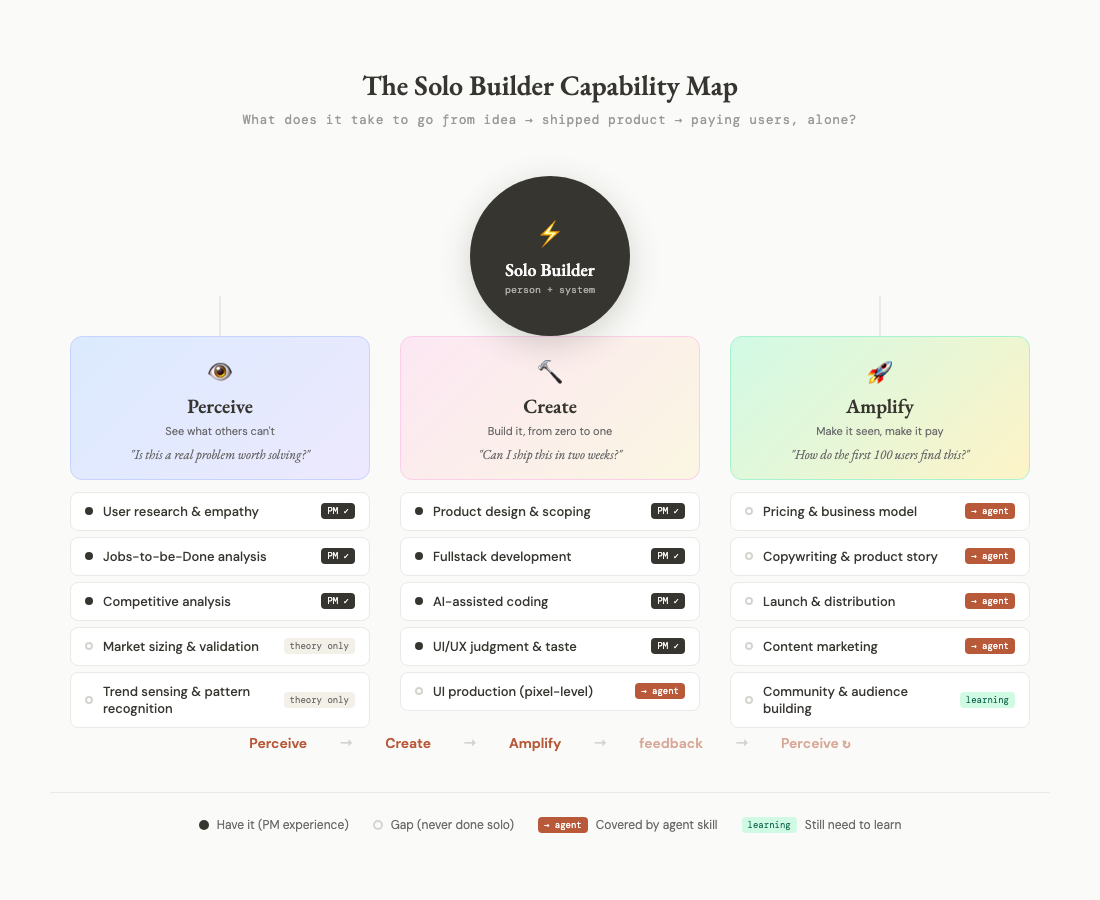
The three things a Solo Builder does
After studying indie builders I admire and reflecting on my own PM experience, I landed on a framework with three layers. I think of it as a flywheel:
👁️ Perceive → 🔨 Create → 🚀 Amplify → (feedback) → Perceive again
Perceive is about seeing problems worth solving. User empathy, market sensing, competitive analysis, pattern recognition. The question at this layer is: “Is this a real problem, and is now the right time to solve it?”
Create is about building the thing. Product scoping, design, development, shipping. The question here is: “Can I get a working version into someone’s hands in two weeks?”
Amplify is about making it seen and making it pay. Storytelling, launch strategy, distribution, pricing, community building. The question: “How do the first 100 users find this, and would they pay?”
Most Solo Builders I’ve observed who struggle aren’t stuck in one layer — they’re stuck in the transition between layers. They perceive problems endlessly but never start building. Or they build forever but never launch. Or they launch once and have no idea how to find users.
The flywheel only works when all three layers are moving. And that requires skills across all three.
Where I actually stand
I mapped my own abilities against this framework. Honestly.
Eight years as a PM gives me a lot. Perceive is mostly covered — I can do user research, JTBD analysis, competitive analysis. I’ve done this thousands of times. Create is strong too — product design thinking, scoping, fullstack development, AI-assisted coding. I know how to build things and I have opinions about what good UI looks like.
But here’s the uncomfortable part: the entire Amplify layer is theoretical.
Pricing strategy. Copywriting. Content marketing. Launch playbooks. Distribution channels. Community building. I understand these things. I’ve sat in meetings with the people who do them. I’ve reviewed their plans, given feedback, approved their budgets. But I’ve never done any of them myself, end to end, from zero.
In a big company, there’s always someone else. A marketing team handles distribution. A pricing analyst runs the models. A content strategist writes the copy. A designer makes the landing page pixel-perfect. As a PM, you orchestrate — you don’t execute.
That’s the real gap. Not “I don’t know how.” It’s “I’ve never done it alone.”
And knowing how something works in theory is very different from doing it at midnight with no one to review your work.
The hypothesis: person + system
There’s a mental model I keep coming back to: a strong person = a person + their system.
PMs build systems for their teams. Sprint processes, decision frameworks, documentation templates. The system handles the repeatable parts so people can focus on judgment calls.
What if I could do the same thing for myself as a Solo Builder? What if the skills I’ve only ever exercised through other people’s hands could be covered by an AI agent — producing the first draft, the first artifact — that I could then apply my existing PM judgment to?
I have the taste. I have the ability to evaluate. What I’m missing is the ability to produce from scratch. The agent could be the bridge.
I already had a project agent for my day job. What I needed now was a different one entirely: a Solo Builder copilot designed around the Perceive → Create → Amplify flywheel.
Building the agent
The system prompt: teaching AI to think in flywheels
The core of the agent is its system prompt — a detailed operating manual that defines not just what it knows, but how it thinks.
The key design decisions:
-
Layer awareness. When I bring the agent a task, it first identifies which flywheel layer it belongs to — Perceive, Create, or Amplify — then activates the corresponding mindset. A Perceive conversation challenges assumptions. A Create conversation cuts scope. An Amplify conversation pushes for distribution strategy.
-
The Challenger role. The agent is explicitly told not to be a yes-man. When I’m excited about an idea at midnight, its job is to ask uncomfortable questions before I invest a week building the wrong thing. “Who specifically has this problem, and what are they doing about it today?”
-
Flywheel check. At the end of significant interactions, the agent checks: is the flywheel spinning? If I’m stuck researching, it pushes me to build. If I’m stuck building, it pushes me to ship. If I’m obsessing over marketing without product-market fit, it pulls me back to the user.
-
Bias toward action. Every response ends with a concrete next step. Not “think about X” but “do X by Friday.”
The skills: from community to custom-built
Skills are where the agent gets its hands and feet. Each one is a self-contained module — instructions, templates, frameworks, and anti-patterns — that teaches the agent how to execute a specific job.
I got them from two sources:
Community skills I adopted. The agent platform has a skill marketplace. I searched for skills that matched Solo Builder needs — frontend design, web asset generation, slide creation, brainstorming frameworks, writing and publishing tools. These gave me a strong foundation without building from scratch.
Custom skills I built myself. For the gaps specific to my situation — the Amplify layer — I designed skills from the ground up. These encode the knowledge I have from years of working alongside specialists, turned into repeatable workflows the agent can execute.
Here’s how they map to the flywheel:
👁️ Perceive Skills
- Second Brain — captures ideas, links, observations into a persistent library. Connects dots across entries over time
- MVP One-Pager — takes a vague idea and forces it through validation filters: pain intensity, frequency, alternatives, founder fit, market timing. Outputs a scoped 2-week build plan
🔨 Create Skills
- Frontend Design — produces production-quality HTML interfaces: landing pages, app screens, design explorations
- Design Thinking — competitive visual analysis, persona generation, UX copywriting. The systematic design research I’d normally skip
- Web Asset Generator — favicons, app icons, OG images, social cards. The “last mile” assets you need before shipping
🚀 Amplify Skills
- Product Story — transforms feature lists into narratives. Uses the ABT framework (And-But-Therefore). Generates copy for landing pages, social posts, pitch scripts, email sequences
- Pricing Advisor — calculates unit economics, generates pricing models with trade-offs, tells you how many paying users you need
- Launch Playbook — channel-specific launch plans with templates for Product Hunt, Hacker News, 小红书, 即刻, Reddit
- Xiaohongshu Carousel — turns articles into visual image carousels for 小红书 with matching caption copy
🔄 Meta Skills
- Weekly Builder Review — structured retrospective that checks each flywheel layer: what did I perceive, create, and amplify this week?
- Onemilelab Publisher — drafts and publishes articles to this site with one conversation. The writing pipeline I described in a previous post
The pattern: every unlit node on my capability map has a corresponding agent skill. Not a perfect replacement — but a competent first draft that activates the judgment I already have.
The experiment: one evening with Murmur
Skills are theory until you run them on a real problem. So I picked an idea I actually care about — Murmur (低语), a voice-first journaling app — and ran it through the entire flywheel in one sitting.
The idea came from a genuine pain: I’ve tried to keep a journal dozens of times. Always quit. The problem isn’t motivation — it’s that writing triggers self-editing. You start thinking about word choice instead of what you actually feel. Voice doesn’t have that problem. You just talk.
Perceive: challenging the idea
I described the idea. The agent didn’t say “great!” — it pushed back. “Who specifically has this problem, and what are they doing about it today?”
It identified three friction layers: acquisition friction (no notebook handy), expression friction (writing triggers self-editing), blank-page friction (where do I even start?). Then framed the job-to-be-done: “Capture thoughts and feelings before they disappear, without it feeling like work.”
As a PM, I know how to do this analysis. But having the agent articulate it forced me to be specific in a way I might have skipped if I were just thinking in my head.
Create: scoping and designing
The MVP One-Pager skill produced a 2-week build plan. The part that hit hardest was the “One Thing Test” — if you could only ship one feature, what would it be? Answer: voice recording + AI polish + show the result. Five features in, six features explicitly out with reasons why they can wait.
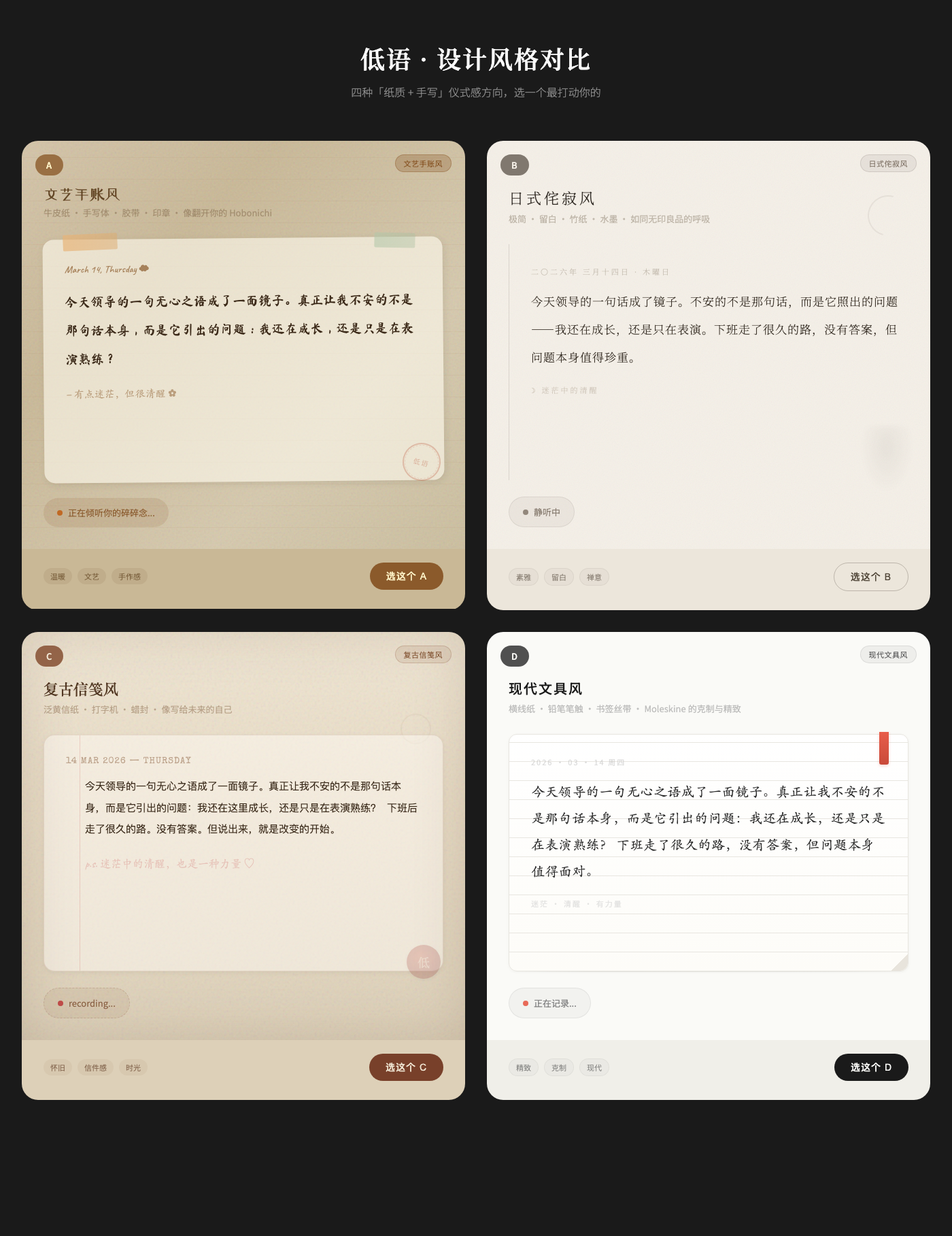
Then the Frontend Design skill produced four complete design directions — each one an interactive HTML mockup I could open in a browser. A hand-drawn journal style, a wabi-sabi minimalist approach, a vintage letter look, and a modern Moleskine aesthetic.
I chose wabi-sabi immediately. Not because the agent told me to — but because I know what I want this product to feel like. I’ve reviewed hundreds of design comps in my career. The difference was that I’d never been the one producing the options.
The final landing page:

Amplify: copy, pricing, and launch
This was the layer where I felt most out of my depth.
The Product Story skill generated a full copywriting package for the Chinese market. Landing page headline: “说出来就好。剩下的,交给我。” (Just say it. I’ll take care of the rest.) A 小红书 post, a 即刻 post, a 3-minute B站 video script with shot descriptions, and single-line copy for every platform.
The Pricing Advisor calculated per-user costs (¥2.46/month), recommended a freemium model, and worked out that 200 early-bird lifetime passes at ¥168 each would cover six months of API costs. I’d never set a consumer price in my life. Having a complete model to react to — to poke holes in, to adjust — was completely different from starting from zero.
Start to finish: one evening. One conversation. From “I have an idea about voice journals” to a scoped MVP, a designed landing page, a pricing strategy, and platform-specific launch copy.
That’s the moment I understood what this agent actually is. Not a tool. A bridge between my judgment and my execution gap.
What surprised me
People connect with moments, not methods
I turned a blog post about writing consistency into a 小红书 carousel. Version 1 was structured and methodical — “two levers: increase feedback, reduce friction.” Clean. Dead.
Version 2 started with: “又断更了,第6次了” (“Quit again. For the sixth time.”). Same content, but it opened with the moment of finding an old Notion page with three entries, the last one reading “这周太忙了” (“too busy this week”).
The gap was enormous. I could have told a junior marketer that v1 needed a personal hook. But when it was my own content, I defaulted to structure. It took seeing both versions side by side to internalize what I’d always preached: the moment earns the right to share the method.
Small things build velocity
Not everything I built was a product. A children’s art gallery for my kid’s drawings. A Chinese character lookup tool. Ten hand-drawn favicon variations for this site. None of these are businesses. But each one was an idea that became real in under an hour.
That velocity — the feeling that any idea in my head can exist before the excitement fades — is what’s actually new. And it’s addictive.
What the agent can’t do
I want to be honest about the limits.
It can’t validate that a problem is real. The MVP One-Pager asks the right questions, but it can’t interview five potential users for me. It can tell me what to ask. It can’t tell me what the answers mean when a real person is hedging and being polite.
It can’t replace taste. The agent generated four design directions for Murmur. All four were competent — polished, cohesive, internally consistent. A non-designer would have a hard time choosing. But I knew within seconds: the wabi-sabi one. Not because of any rational framework, but because it felt like the product I wanted to build — quiet, warm, unhurried. That judgment comes from years of reviewing design work, absorbing what resonates, building an instinct for what fits. The agent can produce the options. It can’t feel which one is right.
It can’t do the uncomfortable work. Posting the 小红书 carousel. DMing five people to try a beta. Setting a price and watching real humans decide whether to click “buy.” The agent makes all of this easier to prepare. The act of putting yourself out there is still entirely human.
The pattern: the agent handles craft — formatting, structure, analysis, first drafts. I handle judgment — taste, conviction, willingness to be wrong in public.
What I actually learned
The agent doesn’t give me skills I don’t have. It activates judgment I already have but never had a chance to use — by producing the raw material for that judgment to work on.
For eight years, my judgment was exercised on other people’s artifacts — a designer’s mockup, a marketer’s copy, an analyst’s pricing model. Now that judgment has my own artifacts to work on, even if the agent produced the first draft.
The shape of learning changed. Instead of learning → doing, it became doing → learning. I ship something with the agent’s help, I see what works and what doesn’t, and the experience teaches me things that studying theory never would.
My capability map still has gaps. But each gap now has a bridge — imperfect, AI-assisted, but functional enough to start crossing.
A strong person isn’t someone who can do everything. It’s someone who’s honest about what they’ve never done — and builds a system that lets them start today.
Nineteen conversations. Four days. One realization: the fastest way to learn the skills I’m missing might be to start using them, badly, with help, right now.
One mile a day. One experiment at a time.